The Eastern Redbud tree,
Cercis canadensia has been a favorite of mine since kindergarten. In the early 1950’s our school sold Redbud trees to help a school fundraiser. They were $ .25 each, and we sold 100’s of trees. Each spring I recall that time of my life and smile a little when I see rosy wafts of color in the still stark woods in Southwest Ohio. Along roads and streams the native redbud probably was not all attributed to my kindergarten class, but I like to think I had a little hand in this hopeful sign of spring.

The Redbud is a short lived tree that is grown in Zones 4 – 9, and when we bought this property, we had four redbuds that had outlived their beauty. As I have documented in past posts, we have also had to remove pines, mulberry, ash, and blue spruce. So with this blank slate, we headed to the garden center to get a Redbud ,’Forest Pansy.’
 |
| Redbud, 'Forest Pansy' |
The lovely dark purple and pink leaves are stunning, and I had my mind made up – until I saw some of the ‘new’ redbuds available in the marketplace. So, let me show you some really great cultivars that breeders have developed in Redbuds.
The tree we finally brought home is a variety called ‘Solar Eclipse’. The variegated green and cream leaf really caught my eye.

This cold hardy tree in Zone 4, had pink-lavender blooms on the stems before leaves appear. The leaves are emerging as a fresh golden orange. This tree will stay small with a mature height of about 12 feet tall.
 |
| Blooms of Redbud, 'Solar Eclipse' |
 |
| New Home for my 'Solar Eclipse' |
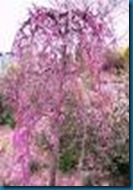
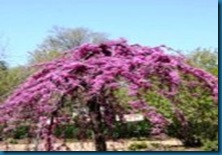
Several varieties of weeping Redbuds that are available are ‘Ruby Falls’, ‘Cascading Hearts’, ‘Lavender Twist’.
 |
| Redbud, 'Ruby Falls' |
 |
| Redbud, 'Cascading Hearts' |
 |
| Redbud, 'Lavender Twist' |
The ‘Ruby Falls’ is a weeping Redbud with tiny pink flowers before dark burgundy foliage appears. As the season progresses the leaves turn a dark green. Finally in autumn, the bright gold foliage takes of the show. ‘Ruby Falls’ is good for a small garden since it’s mature size is only 6’ to 15’ tall.
‘Cascading Hearts’ is another weeping Redbud that will get about 15’ tall also with pendulous branches that are flexible and have a fuller weeping form. This Redbud has great fall foliage of orange and red.
‘Lavender Twist’ is an eastern Redbud in a weeping form and has zigzagging branches that mound to a mature height of 6’ to 8’ tall.
 |
| Redbud, 'Rising Sun' |

‘Rising Sun’ really caught my eye since it’s spring foliage emerges with hints of orange and apricot. Flowers of pink, ‘Rising Sun’ matures at about 15 feet.
 |
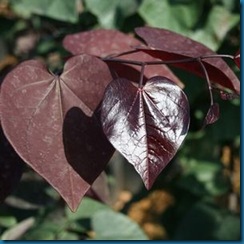
| Redbud, 'Burgundy Hearts' |
‘Burgundy Hearts’, also known as ‘Greswan’ is an eastern Redbud with pink flowers and these lovely glossy reddish-purple leaves. They will fade to a green as the season progresses. Growers believe this burgundy color will stay longer into the season than the ‘Forest Pansy’ leaf does.
 |
| Redbud, 'Merlot' |
‘Merlot’ also has dark purple leaves that emerge after bright pink flowers. Hardy in Zone 6-9, this small 10’ – 15’ dense trees is ideal for small yards.
‘Don Egolf’ will be a popular variety in my opinion. It is a slow grower with dark green foliage, that emerges after vivid, rosy-mauve blooms. This trees is sterile and does not produce seed or unsightly pods, and is not invasive. It is compact in size and can tolerate most any type soil. This variety is a Chinese Redbud,
Cercis chingii.
 |
| Chinese Redbud, 'Don Egolf' |
 |
| 'Hearts of Gold' |
This is the leaf color of an appropriately named variety – ‘Hearts of Gold’. The reddish new growth turns into this lovely gold but will eventually turn green.As the leaves emerge, they change from the opening color of red, to golden yellow and in inner leaves will be green. The emerging leaves can give a show of all three colors at a time for great impact. The flowers are a lavender-purple.

 |
| Redbud 'Royal White' |
One Redbud I saw at the nursery had white blooms. It is ‘Alba – Royal White’ and it was stunning. The ‘Royal White’ blooms earlier than some of the other white redbuds and it’s spring leaves start being burgundy, then fade to green. Later in the season the leaves turn to a blue-green before turning yellow in the fall. It does produce 4” pea pods that wildlife appreciate. ‘Royal White’ is a large Redbud and will peak to 30 feet tall.
 |
| 'Redbud, 'Appalachian Red' |
‘Appalachian Red’ is smaller at a mature height of 15’ to 25’ and is heat tolerant. Deep fuchsia red blooms stand out in the landscape, and the blue/green foliage turns brilliant yellow in fall.
 |
| Redbud, 'Traveler' |
One other type of Redbud is the Texas Redbud. ‘Traveler’ is similar to ‘Lavender Twist’, but the red buds are smaller, and glossy leaves resist fading in the heat of summer.
Other popular Redbud varieties are 'Pink Charm', 'Pinkbud', 'Silver Cloud', and "Flame'. No matter what variety of Redbud you choose, I believe you will have hope and a smile that spring is truly here when these beauties bloom. Arbor Day is April 27, 2013. Let’s celebrate trees and plant a tree or three.


